"Confluent"
While natural language processing and computer vision have transitioned decisively to foundation model architectures, time-series forecasting across enterprise data estates has lagged behind. Organizations have traditionally managed a fragmented patchwork of domain-specific statistical algorithms (such as ARIMA and Prophet) or localized gradient-boosted trees. These traditional pipelines require continuous bespoke retraining, fail to generalize across disparate telemetry modalities, and operate in batch ETL architectures that introduce multi-hour latency—rendering them ineffective for mission-critical fraud detection, industrial telemetry monitoring, and dynamic supply chain re-routing.
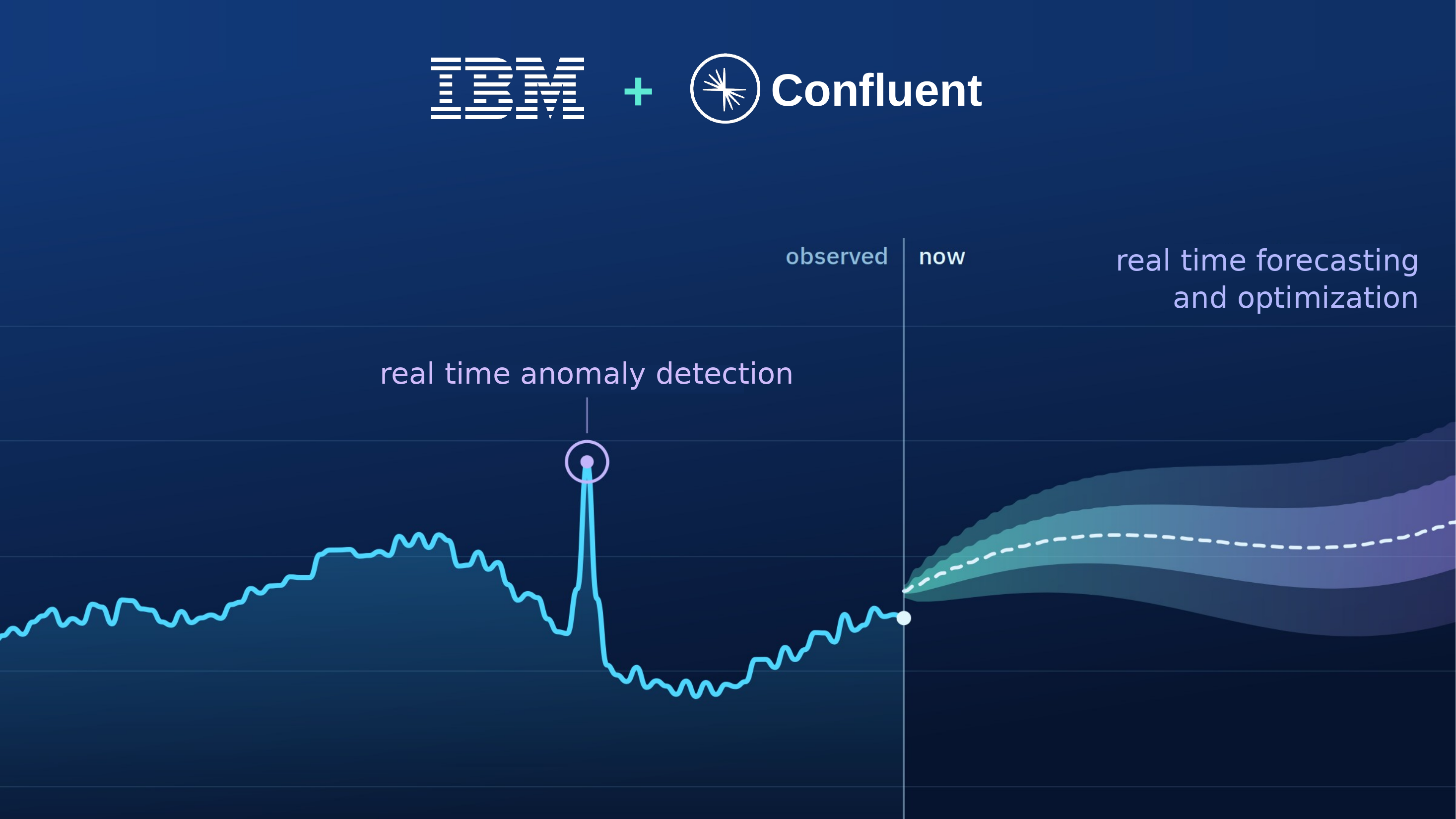
On September 2, 2026, IBM Research and Confluent announced a joint operational architecture integrating the IBM Granite Time Series foundation model portfolio directly into Confluent Cloud and Apache Kafka event streams. By uniting event-driven streaming pipelines with pretrained time-series models (including TinyTimeMixer and Granite-TS), the partnership eliminates the analytical lag between operational data generation and predictive inference, executing zero-shot multivariate forecasting and anomaly detection at sub-second streaming latencies.
Key Breakthroughs.
1. Bringing
Pretrained Foundation Models Directly to Kafka Event Streams In classical architectures, time-series data must land in a data lakehouse, undergo aggregation and cleaning, and run through scheduled batch jobs before actionable insights emerge:
In-Stream Inference Topology: The Confluent-Granite integration embeds lightweight foundation models directly onto streaming topics via Apache Flink and Kafka Connect. Sub-Second Anomaly Scoring: As sensor readings, transaction logs, or supply chain events flow across partitions, the model scores incoming windows in real-time, detecting anomalies and trend shifts before they manifest in downstream databases.
2. Multi-Horizon
Zero-Shot Generalization Unlike traditional forecasting models that break down when presented with unobserved sampling frequencies or missing channels:
TinyTimeMixer (TTM) Backbone: Powered by IBM's compact TTM architecture (ranging from 1M to 5M parameters), the model handles arbitrary context lengths, irregular timestamps, and missing values with robust zero-shot accuracy. Pretrained Cross-Domain Knowledge: Trained on massive corpora of energy grid telemetry, financial market ticks, server metrics, and logistics histories, Granite Time Series models deliver out-of-the-box predictions without costly fine-tuning.
3. Unified
Portfolio Architecture for Heterogeneous Workloads Recognizing that a single model cannot simultaneously optimize high-frequency card payment networks, manufacturing vibrations, and retail inventory:
Granite-TS Portfolio: Provides specialized model tiers—from ultra-compact edge models optimized for continuous sensor streaming to larger multivariate patch transformers for complex multi-echelon demand forecasting.
Technical Specifications & Benchmark Overview
& Platform Overview Dimension / Metric Specification Developing Partners IBM Research & Confluent Release Date September 2, 2026 Model Architectures TinyTimeMixer (TTM), Granite-TS-Patch, Granite-TS-Mixer Streaming Platform Apache Kafka / Confluent Cloud / Apache Flink Inference Latency Single-digit milliseconds per streaming window Tasks Supported Zero-shot forecasting, multivariate anomaly detection, imputation Licensing Apache 2.0 (Hugging Face Open Weights) & Enterprise Managed Cloud
Verified Integration & API Usage
Developers can deploy IBM Granite Time Series inference across streaming telemetry via Python:n
pythonimport numpy as np from tsfm_public.models.tinytimemixer import TinyTimeMixerForPrediction Load pretrained IBM Granite TinyTimeMixer foundation model model = TinyTimeMixerForPrediction.from_pretrained( "ibm-granite/granite-timeseries-ttm-v1", num_input_channels=4, context_length=512, prediction_length=96 ).cuda() Simulate a 512-timestep streaming window across 4 IoT sensor channels streaming_telemetry = np.random.randn(1, 512, 4).astype(np.float32) Execute zero-shot multi-horizon forecast outputs = model(past_values=streaming_telemetry) forecast = outputs.prediction_outputs # Shape: [1, 96, 4] print("Successfully computed 96-step forward forecast across all channels:", forecast.shape)