 Claude Opus 5
What's new in Claude Opus 5
Overview of new features and behavior changes in Claude Opus 5.
Claude Opus 5 is a step-change improvement over Claude Opus 4.8, with the largest gains in deep reasoning, agentic and long-horizon tasks, and test-time compute scaling. This page summarizes everything new in Claude Opus 5, including thinking on by default, mid-conversation tool changes, and a breaking change to when thinking can be disabled.
New model
| Model | API model ID | Description |
|---|---|---|
| Claude Opus 5 | claude-opus-5 | For complex agentic coding and enterprise work |
Claude Opus 5 has a 1M token context window (1M tokens is both the default and the maximum; there is no smaller context variant), 128k max output tokens, and thinking on by default.
New features
Mid-conversation tool changes (beta)
You can add or remove tools between turns of a conversation while preserving the prompt cache, instead of resending a fixed tool list for the life of a session. Mid-conversation tool changes are in beta: include the mid-conversation-tool-changes-2026-07-01 beta header in your requests. See Mid-conversation tool changes for usage.
Default fallbacks mode
The fallbacks parameter supports a new "default" mode, which applies Anthropic's recommended fallback models by refusal category instead of a model list you maintain yourself. The entire fallbacks parameter is in beta. Use the server-side-fallback-2026-07-01 beta header.
Lower prompt cache minimum
The minimum cacheable prompt length on Claude Opus 5 is 512 tokens, down from 1,024 tokens on Claude Opus 4.8. Prompts that were too short to cache on Claude Opus 4.8 can now create cache entries with no code changes.
Fast mode
Fast mode (research preview) is available for Claude Opus 5 on the Claude API only; it is not currently available on Amazon Bedrock, Google Cloud, or Microsoft Foundry. Fast mode for Claude Opus 5 is priced at $10 per million input tokens and $50 per million output tokens.
Behavior changes
Thinking on by default
On Claude Opus 4.8, requests run without thinking unless you set thinking: {"type": "adaptive"}. On Claude Opus 5, the same requests run with thinking on: the model decides when and how much to think on each turn, and the effort parameter is the control for thinking depth. The wire value is unchanged; thinking: {"type": "adaptive"} remains valid and equivalent to the default.
Because max_tokens is a hard limit on total output (thinking plus response text), revisit it for workloads that ran without thinking on Claude Opus 4.8.
The API keeps the option to disable thinking, subject to the effort restriction below.
Effort matters more
Claude Opus 5 converts additional effort into better results more reliably than any earlier Opus model, so the effort level you choose carries more weight. The full ladder is available: low, medium, high, xhigh, and max, with max as the top tier for the deepest possible reasoning. Start at the default, high, and adjust in either direction based on your evals: step down where quality holds to save tokens and latency, or step up for the most demanding work. When running at xhigh or max effort, set a large max_tokens so the model has room to think and act across subagents and tool calls.
This request turns effort all the way up to max:
client = anthropic.Anthropic()

with client.messages.stream(
    model="claude-opus-5",
    max_tokens=64000,
    output_config={"effort": "max"},
    messages=[
        {
            "role": "user",
            "content": "Explain why the sum of two even numbers is always even.",
        }
    ],
) as stream:
    response = stream.get_final_message()

print(response)
Thinking is on by default on Claude Opus 5, so no thinking field is needed.
Disabling thinking requires effort high or below
On Claude Opus 5, thinking: {"type": "disabled"} is accepted only when the effort level is high or below. Setting thinking: {"type": "disabled"} with effort xhigh or max returns a 400 error. This is generally available behavior on Claude Opus 5 onward, enforced on each request, and it is a breaking change from Claude Opus 4.8, where disabling thinking was independent of the effort level. If you disable thinking at high effort levels today, either keep thinking disabled and set effort to high or below, or keep the effort level and remove the thinking field.
Model behavior differences
Beyond the API changes above, Claude Opus 5 behaves differently from Claude Opus 4.8 in ways you may notice without changing any code. Default user-facing responses and written deliverables run longer. In agentic sessions, the model narrates its progress to the user more often. In multi-agent frameworks, it delegates to subagents more readily. It also verifies its own work without being told to, so remove verification instructions carried over from earlier models ("include a final verification step," "use a subagent to verify"); they cause over-verification on Claude Opus 5.
Capability improvements
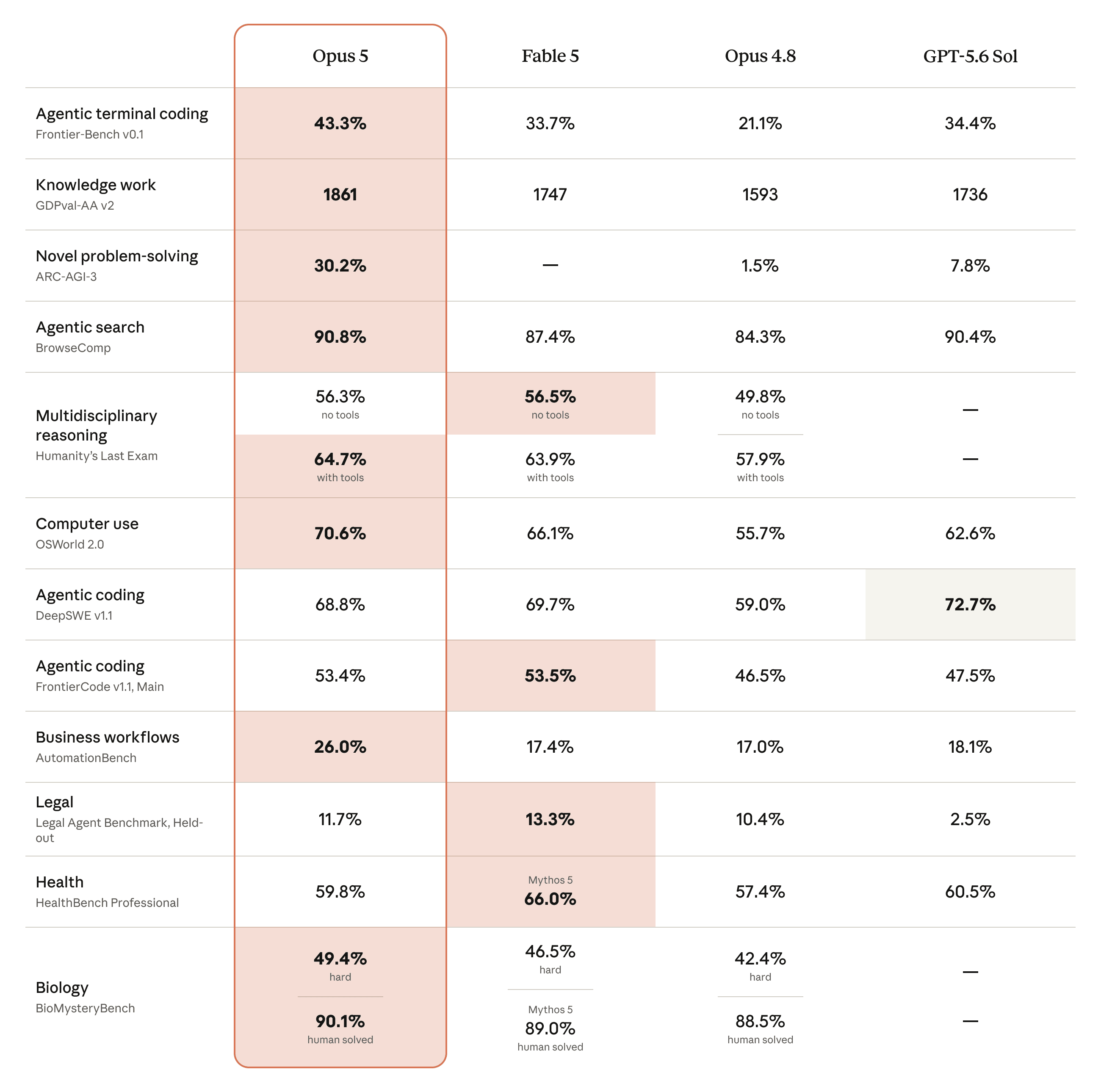
Compared with Claude Opus 4.8, Claude Opus 5 is a step-change improvement rather than an incremental one, and it delivers frontier intelligence at half the cost of Claude Fable 5. The largest gains are in:
- Deep reasoning, sustaining multistep analysis across long problem chains.
- Agentic coding and long-horizon tasks, staying on task across extended tool-use loops and completing multi-file features, larger refactors, and end-to-end feature work without leaving stubs or placeholders.
- Test-time compute scaling, converting additional effort (up to the
maxlevel) into better results. - Efficiency at lower effort levels, with
lowandmediumeffort producing strong quality at a fraction of the tokens and latency of higher settings. - Code review and bug-finding, surfacing real bugs at a high rate per pass with few false positives, and staying accurate at lower effort levels.
- Vision, understanding charts, documents, and diagrams and replicating UI and frontend visuals, strongest when given tools to iteratively analyze, crop, and verify its work.
- Long-context work, with a 1M token context window as both the default and the maximum, and consistent instruction following, tool calling, and reasoning throughout the window.
- Office and document tasks, generating and editing complex multi-sheet spreadsheets with non-trivial formulas, and producing well-structured slide decks.
- Multi-agent coordination, running teams of subagents with effective writer-verifier patterns and few cases of agents overwriting each other's work.
Pricing
Claude Opus 5 is priced at $5 per million input tokens and $25 per million output tokens, unchanged from Claude Opus 4.8. See Pricing for complete pricing, including batch processing, prompt caching, and fast mode rates.
Availability
Claude Opus 5 is available on:
- Claude API: available to all customers, as
claude-opus-5. - AWS: available through Claude in Amazon Bedrock, as
anthropic.claude-opus-5. Claude Opus 5 is also reachable through the InvokeModel API on bedrock-runtime, served by the same infrastructure; the Claude on Amazon Bedrock (legacy) integration does not include it in its ARN-versioned model ID table. - Google Cloud: available through Claude on Google Cloud, as
claude-opus-5. - Microsoft Foundry: available through Claude in Microsoft Foundry.
Claude Opus 4.8 remains available on all of these platforms.
Migration guide
To migrate from Claude Opus 4.8, update your model ID:
model = "claude-opus-4-8"  # Before
model = "claude-opus-5"  # After
Then review the two behavior changes: thinking is on by default, and disabling thinking with effort xhigh or max returns a 400 error. See the migration guide for step-by-step instructions.
Official Visual Benchmark Charts
Key Features
1M token context window (default and maximum)
Thinking on by default with adjustable effort levels (low to max)
Mid-conversation tool changes while preserving prompt cache
Fast mode for higher output tokens per second
Deep reasoning and agentic coding capabilities
You might also want to compare
Verified Sources
Tags
Model Specs
Parameters
Undisclosed
Context Window
1M tokens
Tier
Opus
License
Proprietary
Deployment
Pricing
- 1M input tokens$5
- 1M output tokens$25
- Fast mode:1M input tokens$10
- Fast mode:1M output tokens$50
Resources & Links
Lineage
Predecessor
Claude Opus 4.8Compare Specs
Compare parameters, context windows, modalities, and benchmark scores of this model side-by-side with others.
Compare Model