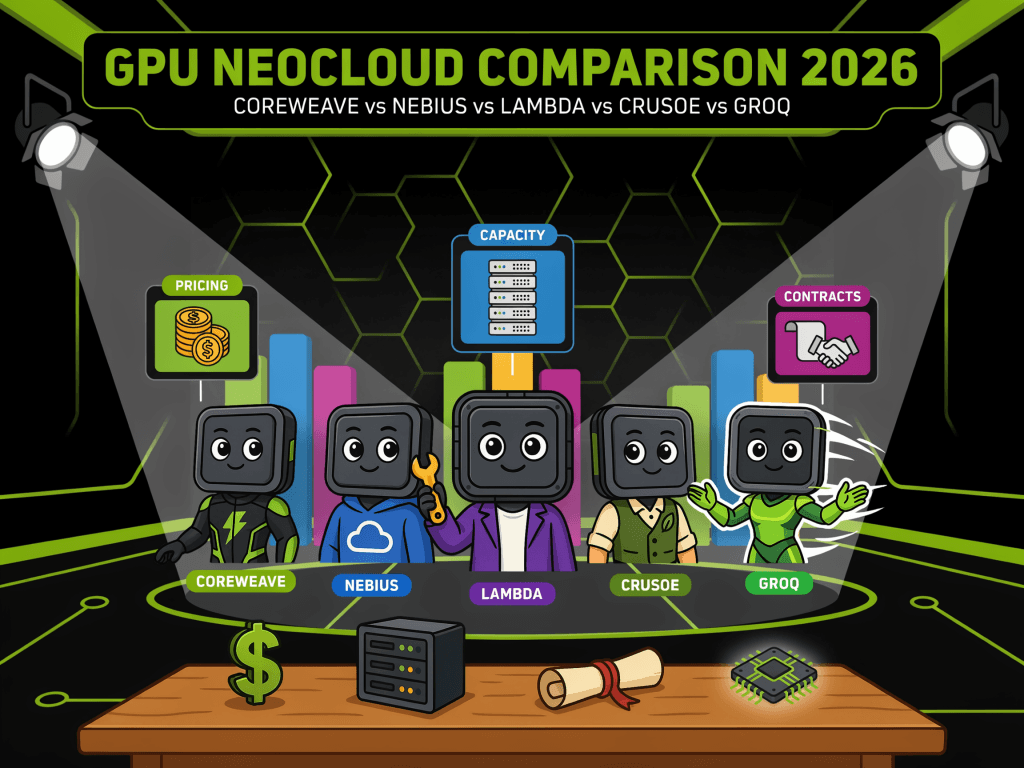
The neocloud label covers five firms with mixed ownership. CoreWeave and Nebius are public; Lambda and Crusoe are private but heading toward IPOs. Groq, which launched its LPU‑based GroqCloud in 2024, licensed its inference technology to NVIDIA in late 2025 and continues to operate its own cloud.
Recent filings and press releases show the following scale and financial highlights for each provider.
- CoreWeave: Q2 2026 revenue $2.575 B, backlog ≈$104 B, active power 1.5 GW, contracted power 3.7 GW (4.2 GW+ across 51 sites), net loss $626 M, FY 2026 guidance $12.4‑13.2 B revenue, $35‑39 B capex.
- Nebius: Q2 2026 group revenue $582.3 M (AI cloud $574.9 M), adjusted EBITDA margin 49.7 %, capex ≈$5.7 B, cash $8.0 B, contracted power target 5 GW by year‑end, plans >1 GW/yr from 2027.
- Lambda: Private, Series E >$1.5 B (Nov 2025), $1 B senior secured credit facility (May 2026), multiyear Microsoft agreement for tens of thousands of NVIDIA GPUs including GB300 NVL72, IPO targeted H2 2026.
- Crusoe: Private, Series E $1.375 B at >$10 B valuation (Oct 2025), contracted AI infrastructure 4.9 GW across five US campuses and Crusoe Cloud, development pipeline >40 GW, building 1.2 GW Abilene site for Oracle/OpenAI and 0.9 GW for Microsoft.
- Groq: Launched GroqCloud Mar 2024 on LPU chips, licensed inference tech to NVIDIA Dec 2025 (~$20 B), runs 13 data centers, power 54 MW → planned 200+ MW by 2027, raised $650 M (Jun 2026) and $350 M (Aug 2026) at $3.5 B valuation, joined NVIDIA Cloud Partner program Aug 2026.
Why this matters
The disclosed power contracts reveal that CoreWeave, Nebius and Crusoe are each securing multiple gigawatts of capacity, indicating a shift toward large‑scale, purpose‑built AI infrastructure rather than generic cloud compute. Groq’s licensing of its inference IP to NVIDIA, while retaining an independent cloud, suggests a bifurcation where chip‑level innovation is monetized through licensing and deployment remains separate. The combined backlog and capex figures point to sustained capital intensity, which will likely affect pricing dynamics and the availability of accelerator resources for model training and inference workloads.
Share this article
Found this insightful? Share it with your community on Reddit, X, or copy the link.