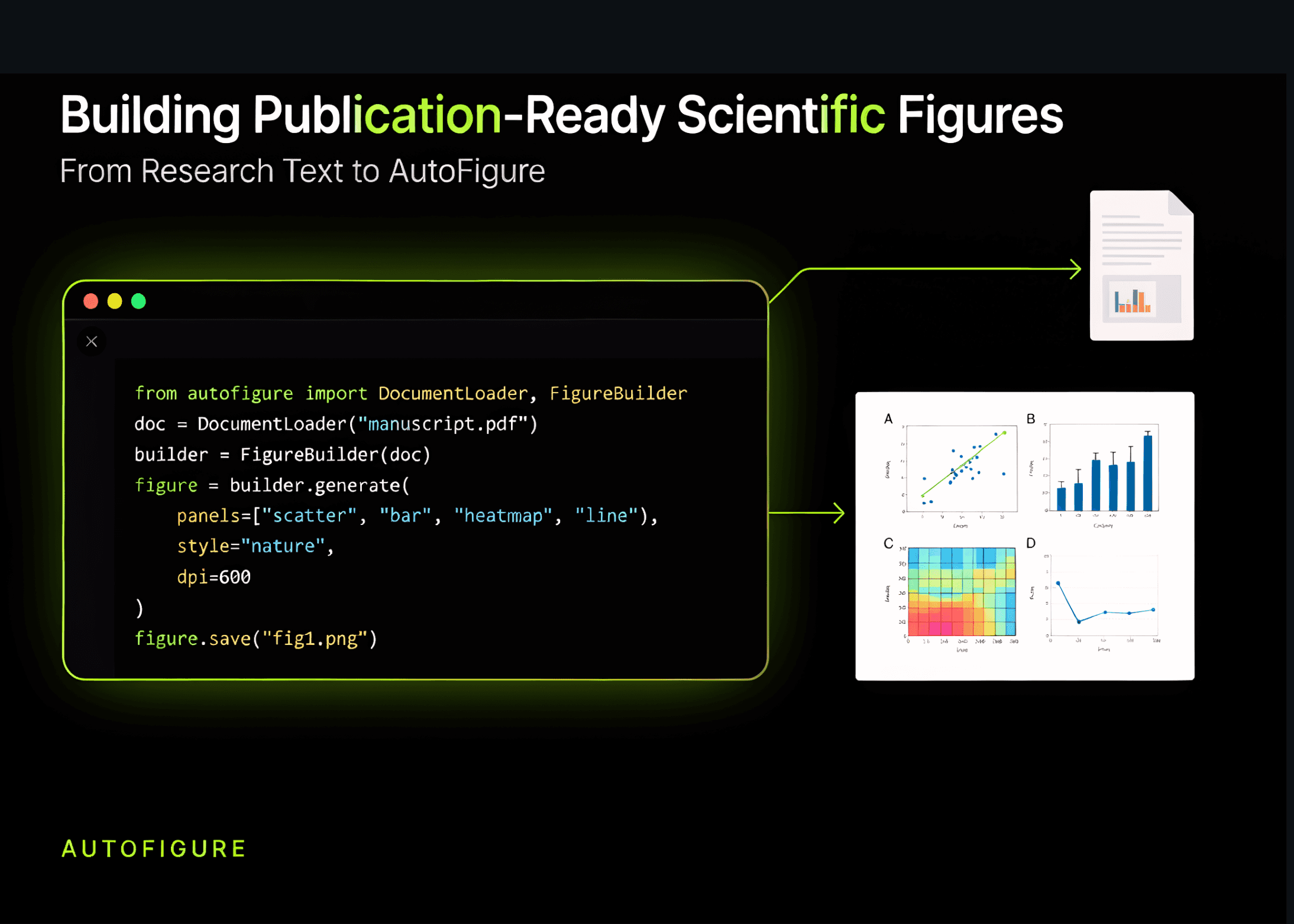
AutoFigure is presented as a end‑to‑end toolkit that converts textual descriptions of complex systems into publication‑ready scientific diagrams. The tutorial begins by installing system libraries, resolving Pillow compatibility, cloning the repository, and configuring a Python environment with the AutoFigure SDK. Offline SVG syntax validation and PNG rendering are performed first to confirm that the local rendering pipeline works before any API‑based calls are made.
The core of the workflow mirrors an agentic document intelligence pipeline: a document normalization layer extracts text, structure, tables, and metadata; a routing planner assigns each segment to one of five expert modules (summarizer, extraction, table, visual, citation); a budget‑aware orchestration layer selects LLM size based on complexity and confidence; and a verification layer checks schema validity, grounding, and consistency before emitting the final analyst‑ready output. AutoFigure exposes these steps through configurable parameters such as the generation model (e.g., google/gemini‑3.1‑pro‑preview), maximum iterations, quality threshold (default 8.5), and output formats (SVG, PNG, or mxGraph XML). Users can supply custom reference images, define an art style, and iterate until the quality threshold is met.
After generating a figure from a detailed method description, the tutorial optionally extracts methodology from a short Markdown paper, creates a PDF, tests text‑to‑figure generation from the PDF, produces editable draw.io mxGraph files, compiles all assets into an HTML gallery, and packages the results into a zip archive for reuse.
Why this matters
The source material shows that AutoFigure decouples diagram creation from manual drawing by leveraging an LLM‑driven agentic loop that iteratively refines SVG code against a quality metric. This reduces the time and expertise needed to produce accurate, reproducible scientific illustrations, especially for rapidly evolving AI pipelines where documentation frequently changes. By integrating verification and cost‑aware orchestration, the system also offers a principled way to balance output fidelity with computational expense, which is valuable for teams that need to version‑control diagrams alongside code and manuscripts.
Share this article
Found this insightful? Share it with your community on Reddit, X, or copy the link.