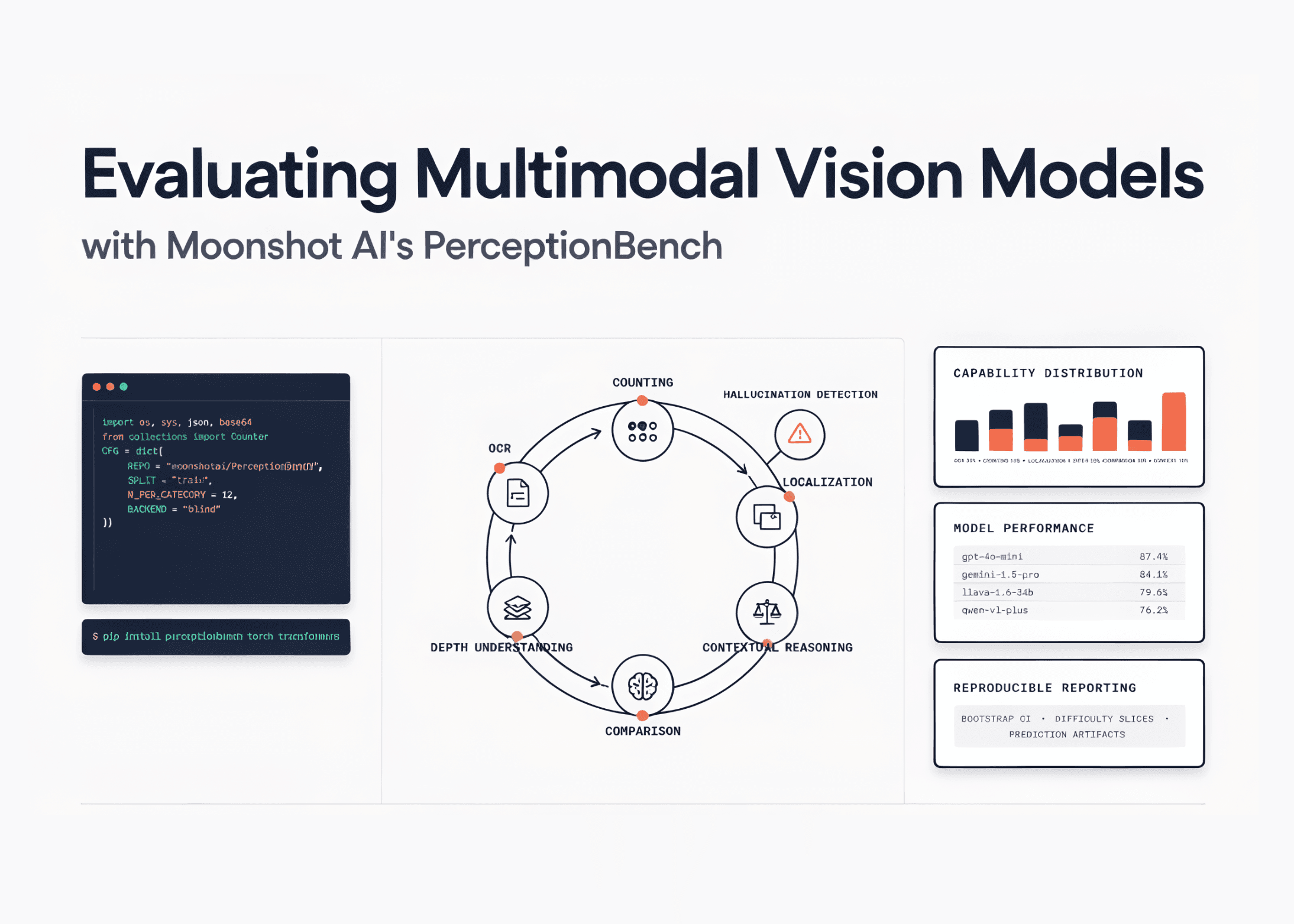
Modelverse is excited to highlight the release of a comprehensive, end-to-end evaluation workflow designed for PerceptionBench, a crucial multimodal benchmark. This new framework empowers developers and researchers to rigorously assess the fine-grained visual perception capabilities of AI models across a diverse set of tasks, including optical character recognition (OCR), object counting, localization, contextual reasoning, comparison, depth understanding, and even hallucination detection. This initiative addresses a critical need in the rapidly evolving field of multimodal AI, providing a standardized and reproducible method to gauge model performance beyond superficial metrics.
The workflow is engineered for robustness, featuring a resilient multi-stage data loading strategy that handles various image encodings and normalizes diverse dataset examples. It integrates a unified evaluation harness compatible with OpenAI-like APIs, local Hugging Face vision-language models, and even a "blind-prior" baseline for foundational comparison. A sophisticated judging system, capable of both rule-based and optional LLM-assisted assessments, extracts and normalizes answers from model outputs, ensuring accurate scoring. Images are intelligently resized and integrated with question text, preserving their contextual relevance.
This evaluation framework is invaluable for the AI community, offering deep insights into model strengths and weaknesses. It moves beyond a single accuracy score to provide detailed capability profiles, performance across difficulty slices (e.g., multi-image questions, varying resolutions), and comparisons against an included leaderboard. Developers can leverage this to refine models, understand failure modes, and explore the impact of prompt variations or image processing techniques. Researchers gain a flexible, reproducible tool to drive advancements in multimodal AI, fostering a deeper understanding of how models truly "perceive" the visual world.