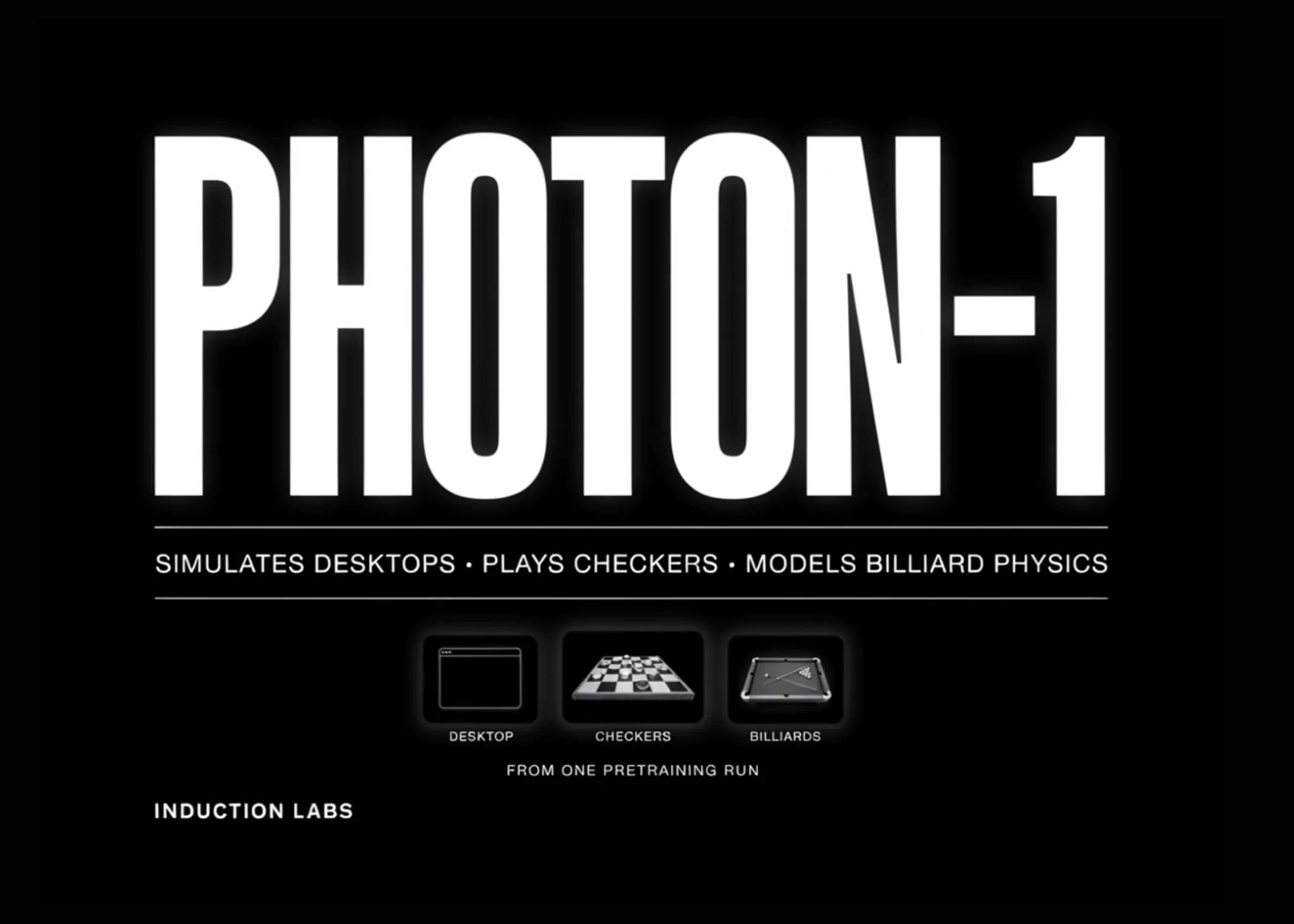
NewsHub NewsHub Premium Content Read our exclusive articles FacebookInstagramX Home Open Source/Weights AI Agents Tutorials Voice AI Robotics Newsletter → Partner with Us NewsHub Search Home Open Source/Weights AI Agents Tutorials Voice AI Robotics Newsletter → Partner with Us Home Artificial Intelligence Applications Induction Labs Photon-1 Simulates Desktops, Plays Checkers, and Models Billiard Physics From... Artificial IntelligenceApplicationsTechnologyComputer VisionEditors PickStaffTech NewsUncategorized Induction Labs Photon-1 Simulates Desktops, Plays Checkers, and Models Billiard Physics From One Pretraining Run By Michal Sutter - July 26, 2026 Most agents that learn from video need to know what action produced each frame. Induction Labs is arguing that this requirement is the bottleneck. Last week, they released imagination models, a foundation model architecture that pretrains on raw video with no action labels at all.
Their test system is Photon-1, a sparse 106B-A5B mixture-of-experts (MoE) transformer trained on 18 years of computer demonstration video. On an internal computer use benchmark, Induction Labs reports that Photon-1 beats Gemini 3.1 Flash-Lite while using far less pretraining compute and costing roughly 3× less to serve.
An imagination model predicts future frames autoregressively using a next-latent-token-prediction objective. It does not generate pixels during pretraining. Everything is modeled in a learned representation space.
The claim that matters is this: predicting future states teaches the model to complete tasks, even though it never sees an action during pretraining. Induction Labs calls this an implicit policy. The model learns concepts of what a person is doing, rather than a label for each mouse click.
The architecture depends on a vision encoder that uses finite scalar quantization (FSQ). Each frame is compressed into 960 discrete tokens. Each token is an 8-dimensional vector. Each dimension takes one of five values: −1, −1/2, 0, 1/2, 1. That gives a codebook of 5⁸ possible codes.
The resulting encoding is about 2.2 KB per frame. Induction Labs reports over 100× better compression than existing OCR and multimodal-model representations, while preserving text, layout and state changes.
To hit that rate, Photon-1 uses a differential latent encoder. It encodes video frames as pairs, so the latents describe differences between frames rather than frame contents.
The corpus starts from an internal index of 2 billion publicly available videos. Filtering reduces that to roughly 2 million computer screen recordings. An internal keyframe detection model strips redundant frames.
Official Announcement
Read the full update directly from the official source at MarkTechPost News.
Stay tuned to Modelverse for real-time model analysis and benchmark coverage.