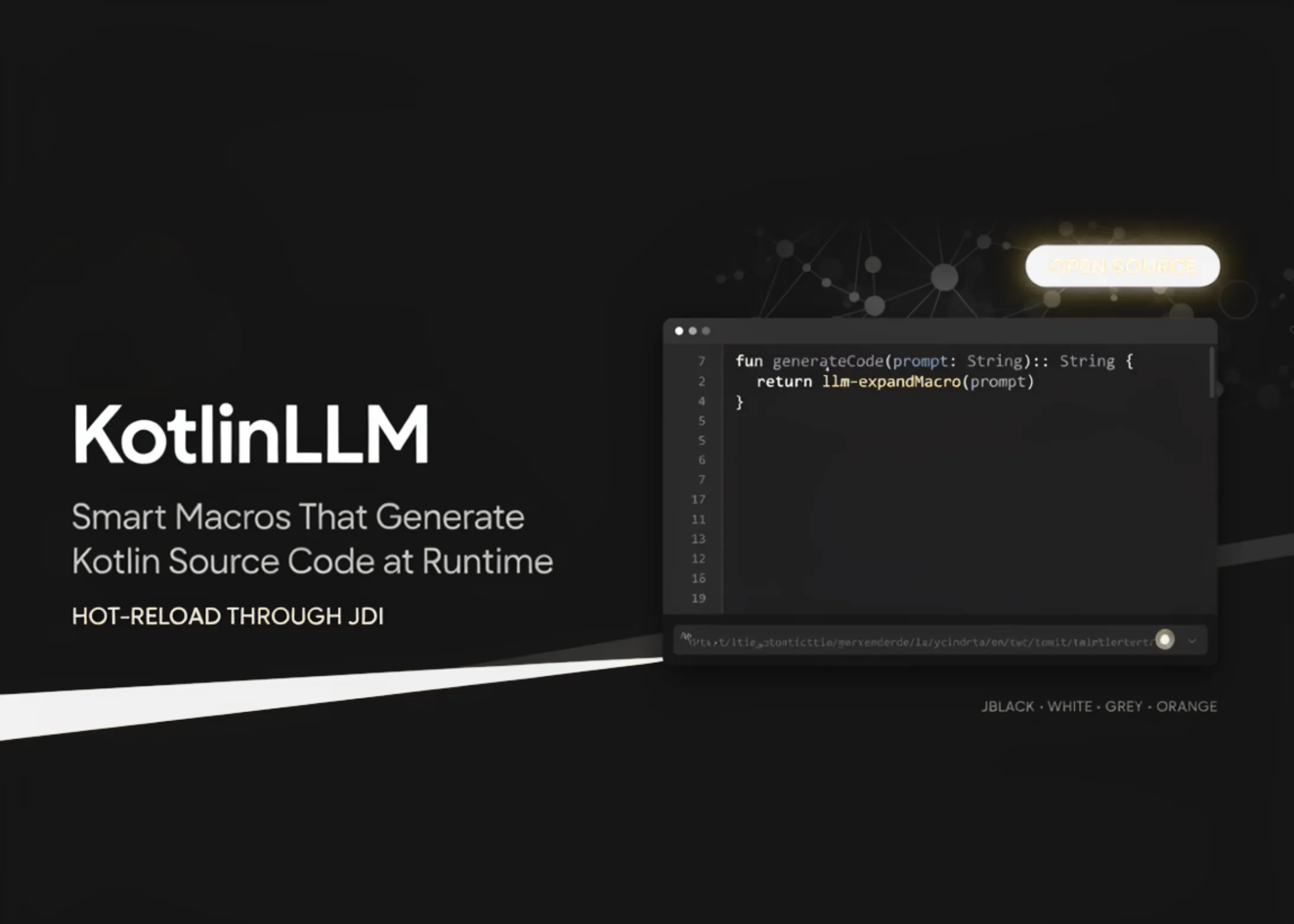
JetBrains Research has open-sourced KotlinLLM, an experimental IntelliJ IDEA plugin for Kotlin/JVM projects that introduces "Smart macros." These are Kotlin function calls, like asLlm<F, T>(from, hint) for type conversion or mockLlm<T>() for generating stateful interface implementations, whose bodies are dynamically generated Kotlin source code by an LLM. Crucially, while a research prototype, its output is deployable: once behavior is generated, the resulting plain Kotlin code can be compiled and run without further LLM interaction for that specific scenario.
The plugin operates via a sophisticated runtime evolution loop. Upon project launch, KotlinLLM identifies Smart macro calls and sets breakpoints. If initial generated logic doesn't match a runtime scenario, execution pauses. The plugin captures runtime context, feeds it to an LLM agent for a code update, then compiles and hot-reloads the new code using JVM class redefinition via JDI. This unique, Kotlin/JVM-specific capability allows applications to dynamically adapt and evolve their code based on real-time execution needs, ensuring robust and context-aware behavior with minimal overhead.
KotlinLLM represents a significant advancement for developers and researchers. Developers gain a novel way to integrate LLMs, enabling dynamic code generation, reducing boilerplate, and simplifying complex tasks. Researchers benefit from an open-source platform to explore runtime code evolution and LLM-driven adaptation. This experimental plugin paves the way for intelligent development environments where code can self-adapt and optimize at runtime.