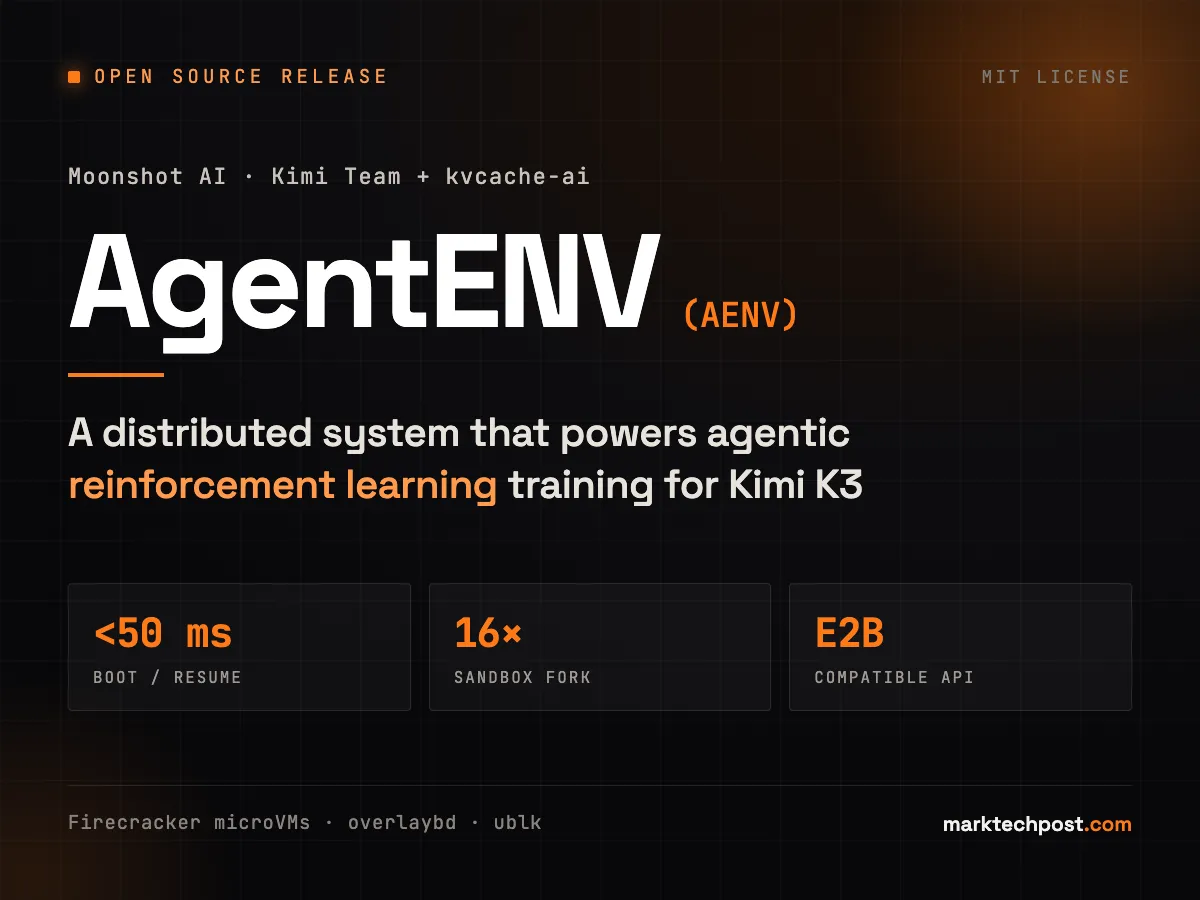
NewsHub NewsHub Premium Content Read our exclusive articles FacebookInstagramX Home Open Source/Weights AI Agents Tutorials Voice AI Robotics Newsletter → Partner with Us NewsHub Search Home Open Source/Weights AI Agents Tutorials Voice AI Robotics Newsletter → Partner with Us Home Editors Pick Agentic AI Kimi AI and kvcache-ai Open Sources 'AgentENV': A Distributed System that Powers... Editors PickAgentic AIArtificial IntelligenceAI InfrastructureTechnologyAI ShortsApplicationsLanguage ModelMachine LearningNew ReleasesOpen SourceSoftware EngineeringStaffTech News Kimi AI and kvcache-ai Open Sources 'AgentENV': A Distributed System that Powers Agentic Reinforcement Learning (RL) Training for Kimi K3 By Asif Razzaq - July 27, 2026 Moonshot AI's Kimi team and kvcache-ai have open-sourced AgentENV (AENV), a distributed platform for running agent environments at scale. AgentENV powers agentic reinforcement learning (RL) training for Kimi K3, Moonshot's 2.8-trillion-parameter Mixture-of-Experts model. The code ships under an MIT license.
Agentic RL does not just sample text. It requires the model to act inside a real computer. Every rollout needs an isolated Linux environment with a filesystem, a network stack, and live processes.
That requirement creates a hard trade-off. Containers start fast but share the host kernel, which weakens isolation for model-generated code. Full virtual machines isolate properly but boot slowly and hold memory while idle.
AgentENV targets exactly that gap. It runs Firecracker microVMs, then makes idle, restart, and branching cheap enough to run at training scale.
Each sandbox is a Firecracker microVM with its own Linux kernel, filesystem, and network namespace. Requests hit an Axum HTTP API, which forwards to an orchestrator that manages the sandbox lifecycle.
Storage is where the design gets interesting. The rootfs is served through a ublk userspace block device backed by overlaybd layered images. Read-only base layers are shared across sandboxes, and each sandbox writes into its own upper layer.
Inside every guest, a daemon called envd handles command execution, file operations, and health reporting on port 49983. A reverse proxy routes HTTP and WebSocket traffic from clients to services running inside the VM.
The project also lists two density mechanisms. The host page cache is shared across storage and memory-snapshot data. Memory ballooning returns reclaimable guest memory to the host, which sustains overcommit as environments diverge over time.
Official Announcement
Read the full update directly from the official source at MarkTechPost News.
Stay tuned to Modelverse for real-time model analysis and benchmark coverage.