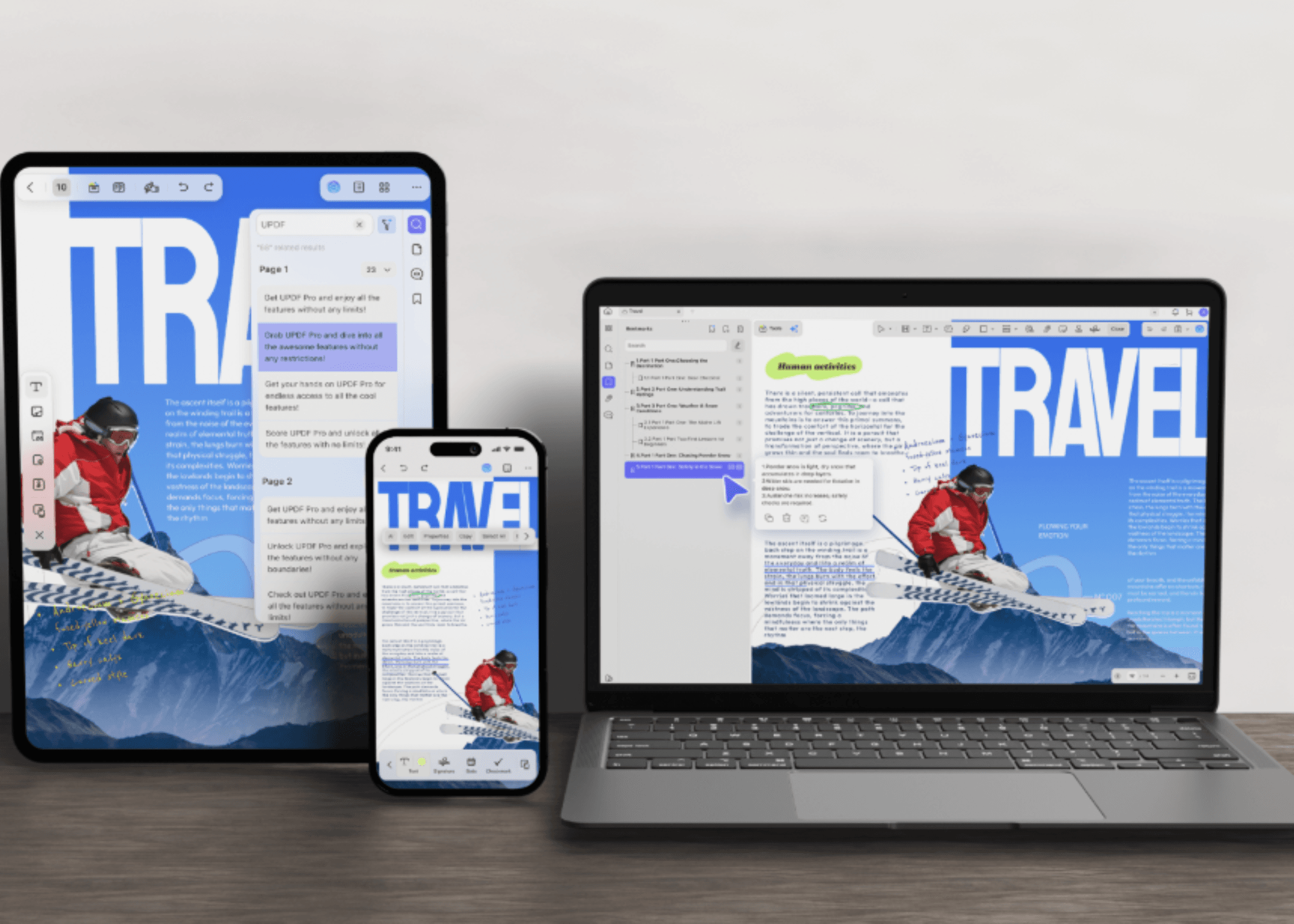
UPDF is a cross‑platform PDF editor available for Windows, macOS, iOS, and Android that bundles traditional editing tools with an integrated AI assistant. Developed by Superace Software Technologies, the application combines annotation, conversion, compression, OCR, page organization, and form handling in a single interface, eliminating the need to switch between a chatbot for interpretation and a separate editor for execution.
Within the editor users can modify text, font styling, images, hyperlinks, and tables directly inside the original PDF while preserving the source layout, fonts, and formatting. Watermarks, backgrounds, headers/footers, form fields, and individual pages are also editable in place. The tool supports filling interactive forms, adding handwritten or image‑based signatures, and synchronizing saved signatures across devices.
The built‑in AI assistant assists with tasks such as summarizing content, extracting data, and suggesting edits, but the core value lies in its ability to apply those suggestions without breaking the document’s visual structure. By keeping the AI and editing functions in the same window, UPDF reduces the friction between understanding a PDF and producing a revised, signable version.
- Available on Windows, macOS, iOS, Android
- Combines PDF editing, annotation, OCR, conversion, compression, page organization, and AI assistant
- Edits text, images, links, tables, watermarks, headers/footers, form fields, pages while preserving original layout
- Supports interactive form filling and cross‑device signature synchronization
- AI assistant provides summarization, data extraction, and edit suggestions without altering layout
Why this matters
Analysis: The source material notes that PDFs are ubiquitous yet resistant to direct modification, and that modern language models can read but not reliably edit them. UPDF addresses this gap by co‑locating AI‑driven interpretation with layout‑preserving editing tools in a single application. If the claimed layout preservation holds true, teams that routinely edit contracts, forms, or compliance documents could reduce the number of software switches and manual re‑creation steps, potentially lowering error rates and saving time. This integration hints at a broader trend where document‑centric AI assistants are paired with native editing capabilities to close the loop between comprehension and production.
Share this article
Found this insightful? Share it with your community on Reddit, X, or copy the link.