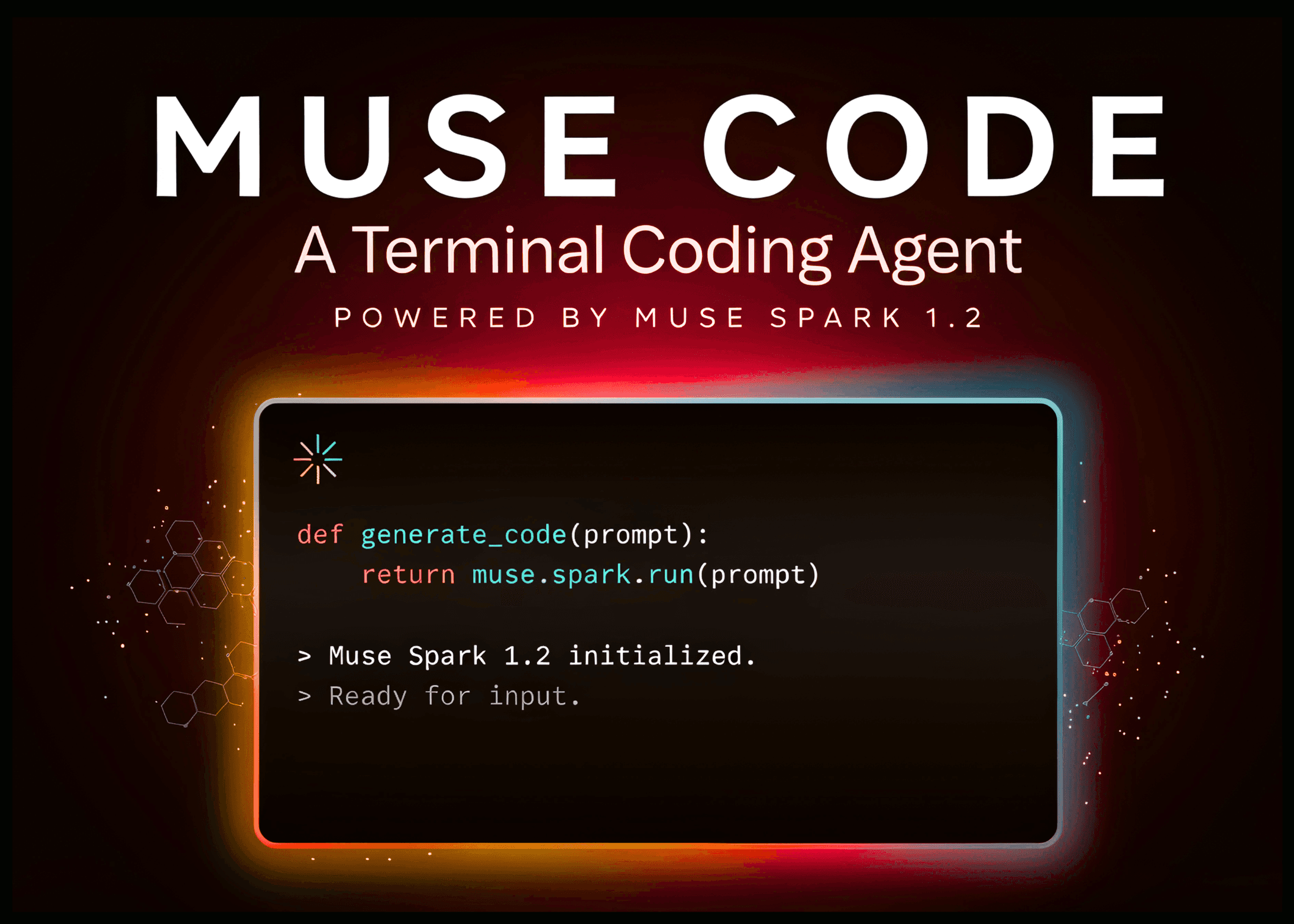
Meta AI has unveiled Muse Code in beta, a new terminal-based coding agent powered by its latest model, Muse Spark 1.2. This release marks Meta's ambition to tackle complex software engineering challenges within extensive code repositories, handling everything from planning and code generation to validation. Muse Code is currently available for macOS and Linux, installable via curl -fsSL https://dev.meta.ai/install.sh | bash. Muse Spark 1.2 is accessible through Muse Code and the Meta Model API, indicating it's a hosted service rather than a downloadable model.
The agent's architecture features persistent asynchronous background agents that remain active throughout a session, eliminating redundant information gathering and reducing latency for multi-step tasks. A local, append-only event log records every action—model calls, tool runs, approvals, and edits—making it "replay-exact and restart-safe." This crucial feature allows long-running tasks to resume precisely where they left off after a crash, significantly enhancing reliability. Muse Code also ships with default skills like /plan for task outlining, /grill for plan stress-testing, and /goal for objective completion.
For developers and researchers, Muse Spark 1.2 brings substantial improvements in code generation, complex debugging, and codebase understanding, achieved through scaled-up training compute and diverse environments. Its significance is further highlighted by a detailed case study where the model iteratively optimized GPU kernels over 1,000+ tool calls, running for up to 24 hours. This demonstrates Muse Code's potential for highly specialized, performance-critical engineering tasks. Meta also benchmarked Muse Spark 1.2 against leading models like Grok 4.5, Claude Opus 5, GPT-5.6 Terra, Gemini 3.6 Flash, and Kimi K3, showcasing its competitive capabilities in the evolving landscape of AI-powered coding.