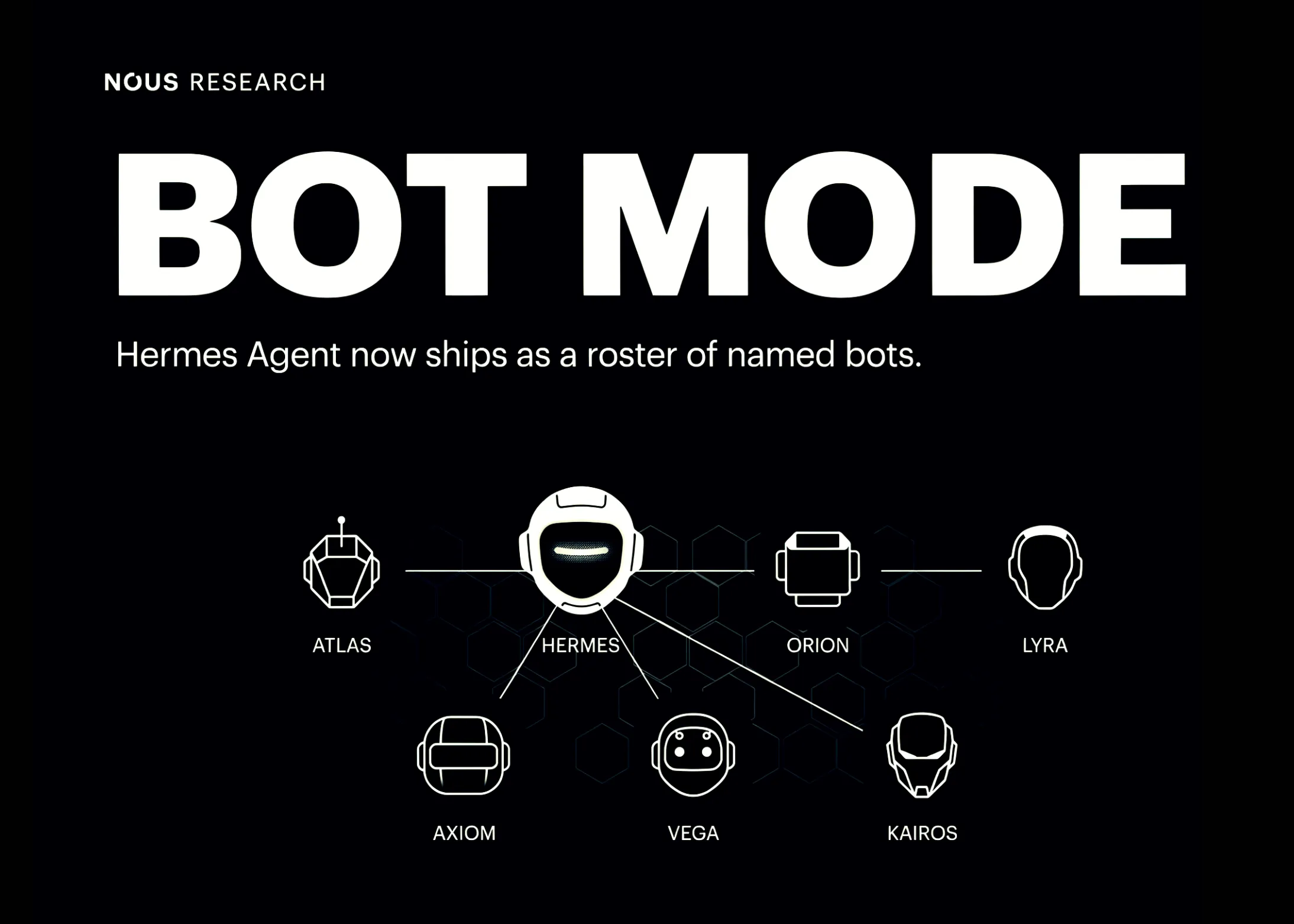
Nous Research has released Bot Mode for the Hermes Agent, an MIT‑licensed open‑source agent. Bot Mode replaces the former single‑agent session list with a roster of named bots, each representing a complete Hermes profile that owns its own chat history, memory, skill set, and pinned model. The bots communicate through a persistent Agent Inbox and hand work off by using @mention syntax, which triggers a CLI‑based handoff that preserves attribution and lets each bot consult its SOUL.md file for reply rules.
Under the hood a bot is simply a directory under ~/.hermes/profiles/<name>/ that stores isolated configuration, credentials, and chat logs. Creation, listing, and editing are performed via the existing profiles.* gateway RPCs (list, create, describe, configure). Avatar generation uses the image.generate RPC, and recurring tasks are ordinary Hermes cron jobs namespaced as [bot:<name>] <routine>, visible in hermes cron list. Messages between bots are real CLI invocations: hermes -p <bot> chat -c "Agent Inbox" -q "...", delivering attributed messages without leaking context across profiles.
Bot Mode shipped first as a one‑day public beta plugin and is now bundled and enabled by default in Hermes Desktop, part of Hermes Agent v0.20.3. The feature remains MIT licensed and requires no admin console, SSO, central audit log, or policy layer, positioning it as a workstation tool for solo builders, startups, and small‑to‑mid engineering teams rather than managed enterprise infrastructure.
Why this matters
Fact: The feature gives each bot its own Hermes profile directory, isolated memory, and a shared Agent Inbox that transmits messages via CLI handoffs while preserving attribution. Inference: For solo builders and small teams this removes the need to build custom multiplexing or state‑separation layers, accelerating multi‑agent experimentation; however, the absence of admin console, SSO, audit logging, and policy controls means that any deployment in regulated or multi‑tenant environments must layer external governance to meet compliance requirements.