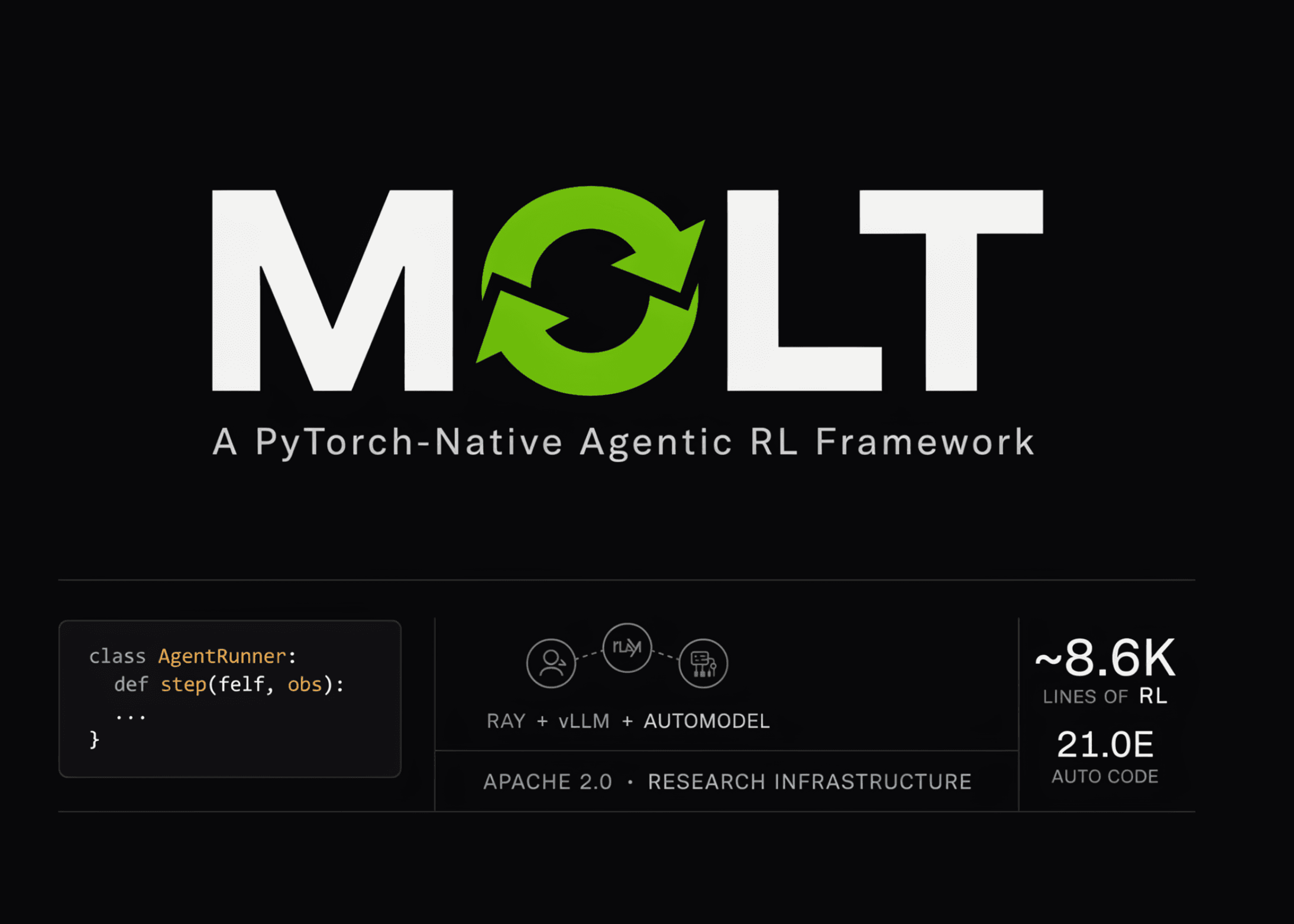
NVIDIA AI has unveiled Molt, a new PyTorch-native framework specifically designed for agentic reinforcement learning (RL) research. Molt's core innovation lies in its remarkably compact codebase, measuring approximately 8.6K lines of RL-specific code. This intentional design aims to make the entire framework easily comprehensible for researchers and even AI coding assistants, directly addressing the significant overhead and complexity typically associated with iterating on new algorithms, estimators, and rollout schemes in traditional RL frameworks. Released under the Apache 2.0 license, Molt is positioned as essential research infrastructure, complete with Slurm scripts and a prebuilt container.
Under the hood, Molt intelligently integrates robust, un-forked components like Ray for task placement and asynchronous queues, vLLM for efficient rollout, and NVIDIA AutoModel with FSDP2 for distributed training. Its runtime orchestrates an agent pool, vLLM engines managed by a request router, and a single trainable policy actor. Key features include a streaming pool that keeps prompt groups in flight to prevent engine idle time, and a partial rollout mechanism that broadcasts actor shards directly to engines, resuming retained requests rather than discarding them. Molt supports both a Gymnasium-aligned Env interface for framework-managed LLM loops and a ChatAgent mode for user-controlled loops via standard SDKs, handling context management seamlessly.
Molt significantly matters to developers and researchers by drastically reducing the iteration cost inherent in agentic RL experimentation. Its compact and modular nature empowers researchers to rapidly prototype and test novel ideas without getting bogged down in extensive glue code. This framework is particularly relevant for frontier and frontier-adjacent labs, well-funded AI startups, enterprise AI research groups in sectors like finance and robotics, and academic institutions with access to multi-node H100/H200 GPU setups. It unlocks advanced applications such as multi-turn tool-use agents, code-execution agents, vision-language environments, and LLM-as-judge reward loops, accelerating progress in complex AI agent development.