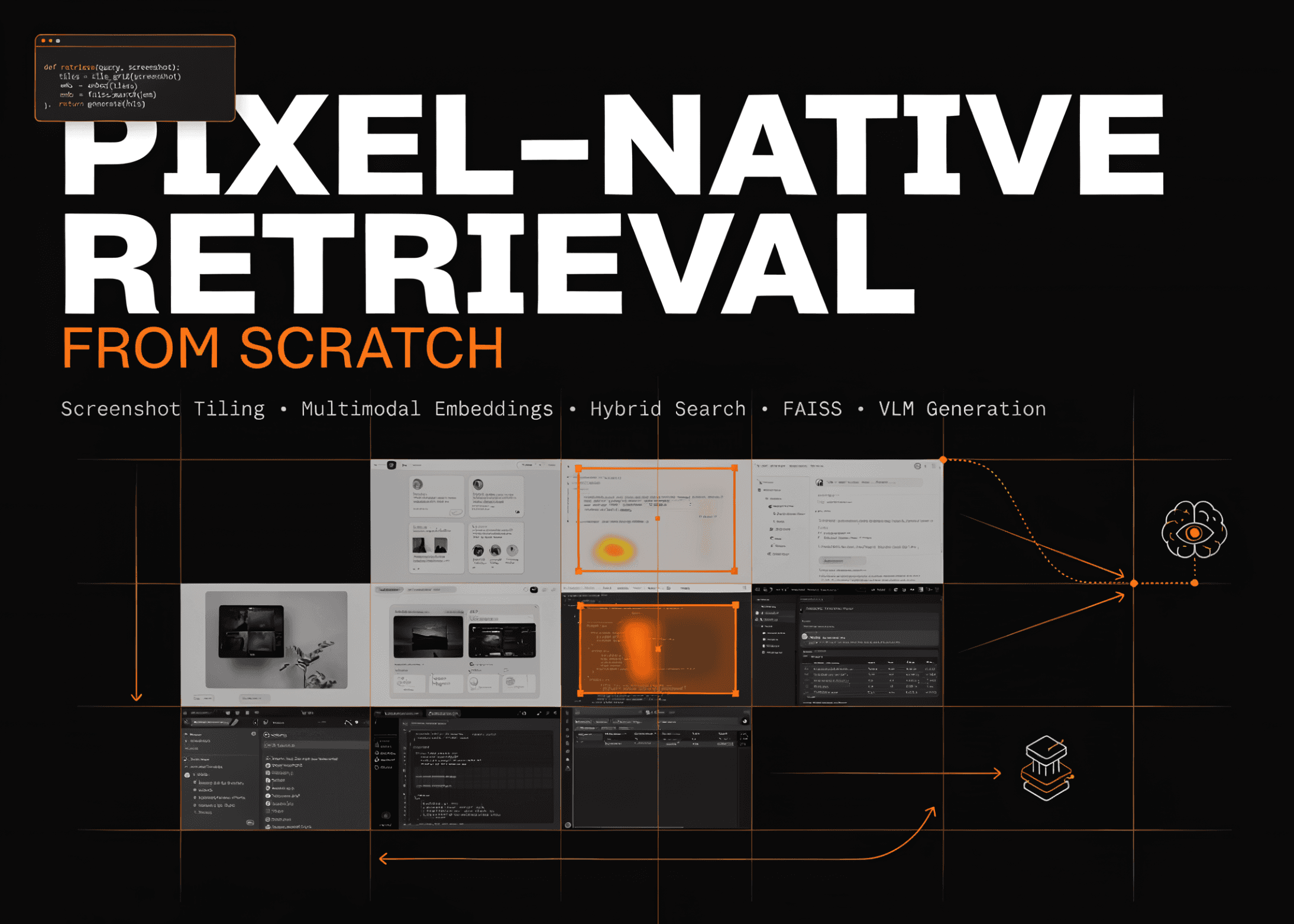
Modelverse is excited to highlight a new, comprehensive tutorial on "Pixel-Native RAG," a groundbreaking approach to visual document indexing that moves beyond the limitations of traditional text-based retrieval. This innovative pipeline treats web pages and PDF documents as visual entities, sidestepping conventional HTML parsing, text extraction, and rigid chunking strategies. It offers developers and researchers a robust framework for building more resilient and accurate retrieval-augmented generation (RAG) systems, particularly for visually rich or complex content.
The core of Pixel-Native RAG involves rendering documents into images, which are then meticulously divided into overlapping tiles to preserve context. Multimodal embeddings are generated for these image tiles using advanced models like SigLIP, CLIP, or an optional Qwen3-VL backend, and subsequently stored in a FAISS index for efficient similarity search. To further enhance retrieval accuracy, the system incorporates OCR-based BM25 scoring for sparse retrieval, fusing these results with dense vector rankings via reciprocal rank fusion. An optional lightweight residual adapter can also be trained using contrastive learning to refine embedding quality.
This practical guide is invaluable for developers and researchers aiming to push the boundaries of RAG. It provides a complete, from-scratch implementation, including evaluation metrics and a FastAPI service for easy deployment and experimentation. By focusing on pixel-level understanding, Pixel-Native RAG offers a powerful solution for indexing diverse document types and directly feeding visual evidence to vision-language models for grounded answer generation, paving the way for truly multimodal AI applications.