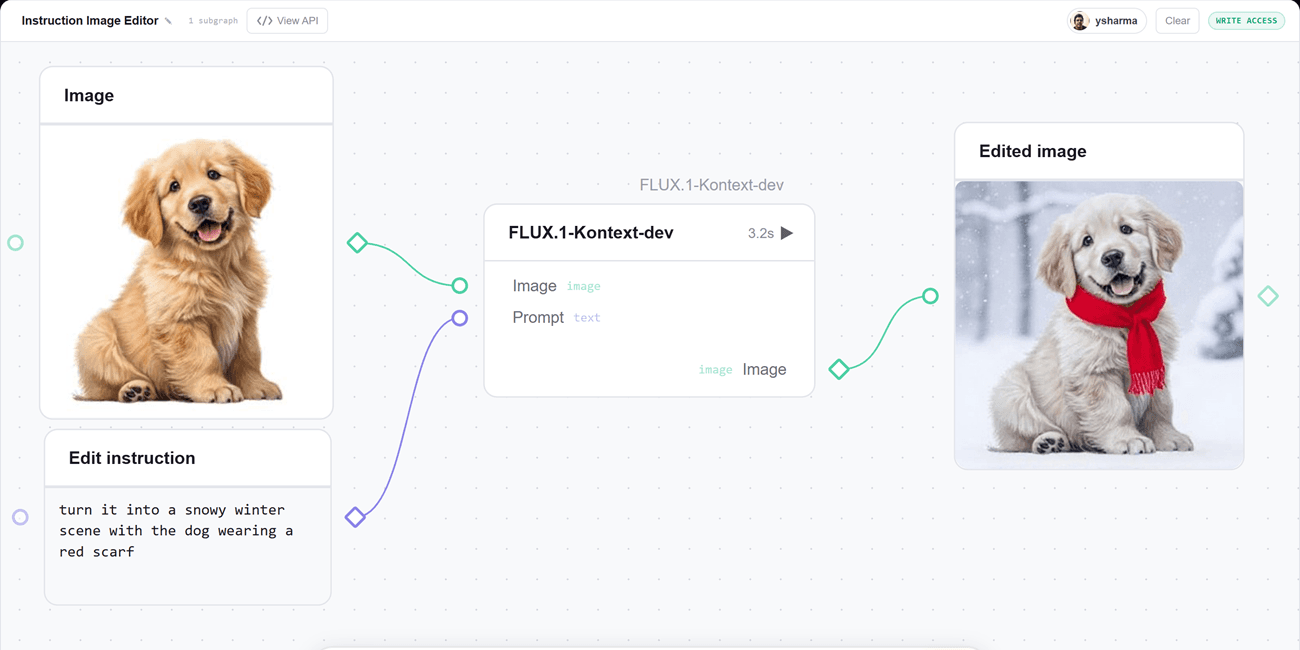
Gradio’s Blocks API lets developers assemble UI components into directed graphs where each node can be a data input, model inference step, or post‑processing widget. Connections are defined with Python callbacks that can be synchronous or asynchronous, allowing state to be passed between steps without rebuilding the interface. The framework automatically handles layout, CSS theming, and event routing, so a workflow that chains a text tokenizer, a transformer encoder, and a sentiment visualizer can be expressed in under fifty lines of code.
Once defined, the workflow can be launched locally with a single launch() call, served through Hugging Face Spaces via a Git‑backed repository, or containerized with Docker for cloud‑native deployment. Gradio also exports the interface as a static HTML bundle for embedding in internal portals. The project is released under the MIT license and requires Python 3.8 or newer; it ships with official bindings for TensorFlow, PyTorch, and JAX, and provides a component registry for custom inputs/outputs.
- Python 3.8+; MIT license
- Async callbacks & shared state
- Local, Hugging Face Spaces, Docker deployment
- Static HTML export & custom component support
Why this matters
By reducing the boilerplate needed to wire together preprocessing, model, and visualization steps, Gradio shortens the iteration cycle for ML researchers and enables teams to share reproducible demos without maintaining separate frontend codebases.
Share this article
Found this insightful? Share it with your community on Reddit, X, or copy the link.